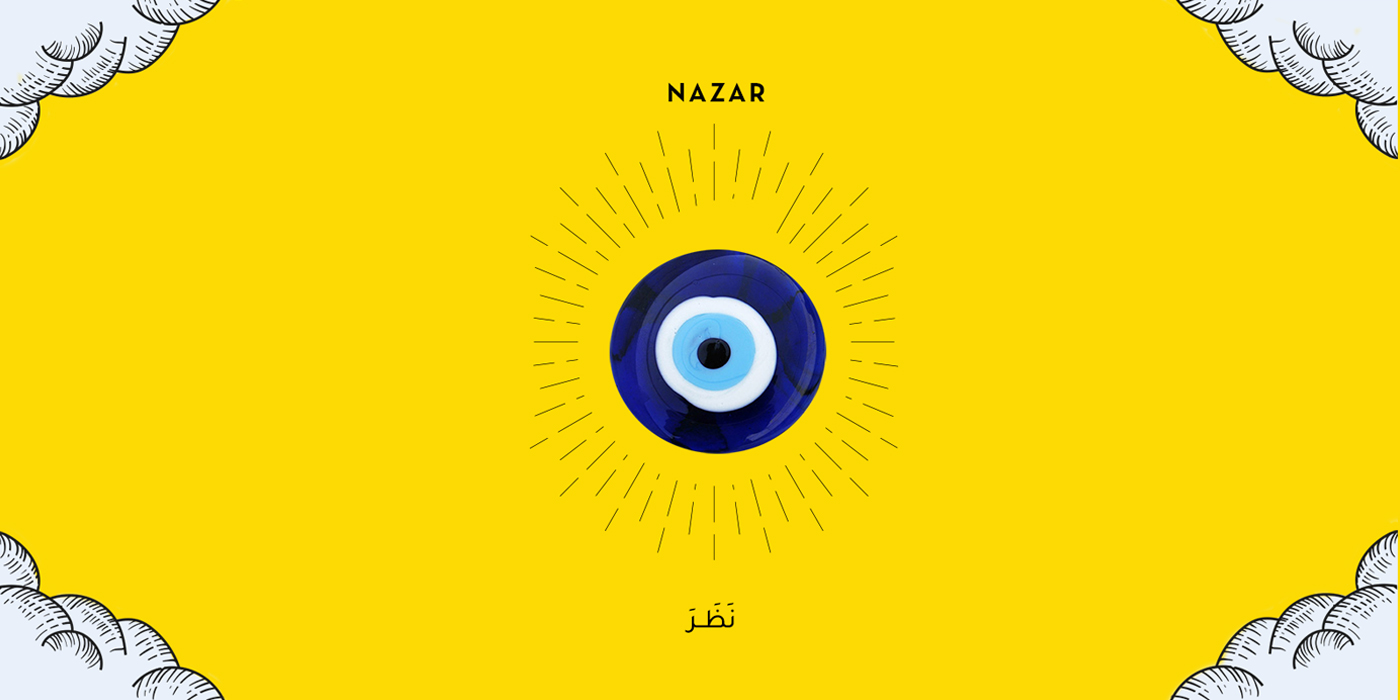
It appears on Turkish ceramic tiles, Neapolitan coral jewellery, Jordanian embroidery, and on the back windows of taxis from Cairo to Mexico City. The eye — blue, dilated, always watching — is one of the most persistent symbols in human visual culture.
"The evil eye is not superstition. It is a theory of vision — the idea that the gaze itself has physical power."
Its origins are difficult to pin down because they seem to exist everywhere at the same time: ancient Mesopotamia, classical Greece and Rome, the Arab world, the Indian subcontinent. It feels like different cultures, in different places, arrived at the same visual answer to the same human fear.
What makes it so interesting from a design point of view is its stability. Across thousands of years and many cultures, the symbol barely changes: a stylised eye, usually blue, often made of concentric circles — simple, but extraordinarily powerful.
During my trip to Istanbul, I saw Nazar eyes hung on doors, windows, and even in gardens on trees. When the sunlight passed through the blue glass, it created reflections that felt almost magical. It wasn't the first time I had seen this amulet — I remember it also from my trip to Morocco.
In Turkey they call it the Nazar. In Morocco, some people refer to it as the Eye of Allah — but I was also told by women in Jordan that this name is considered haram, forbidden, because in Islam the idea of protective objects and magic can be controversial.
Still, the story of this amulet stays with me. It is more than an object. It feels like something that has quietly travelled across cultures for millennia, carrying the same idea of protection, fear, and the power of being seen.
I bought a very large one. It hangs in front of my front door.
What strikes me, looking at it now, is how little it needs. One shape. One colour. Five thousand years of the same idea. As a designer, I spend a lot of time trying to build symbols that last. The Nazar was already there.